
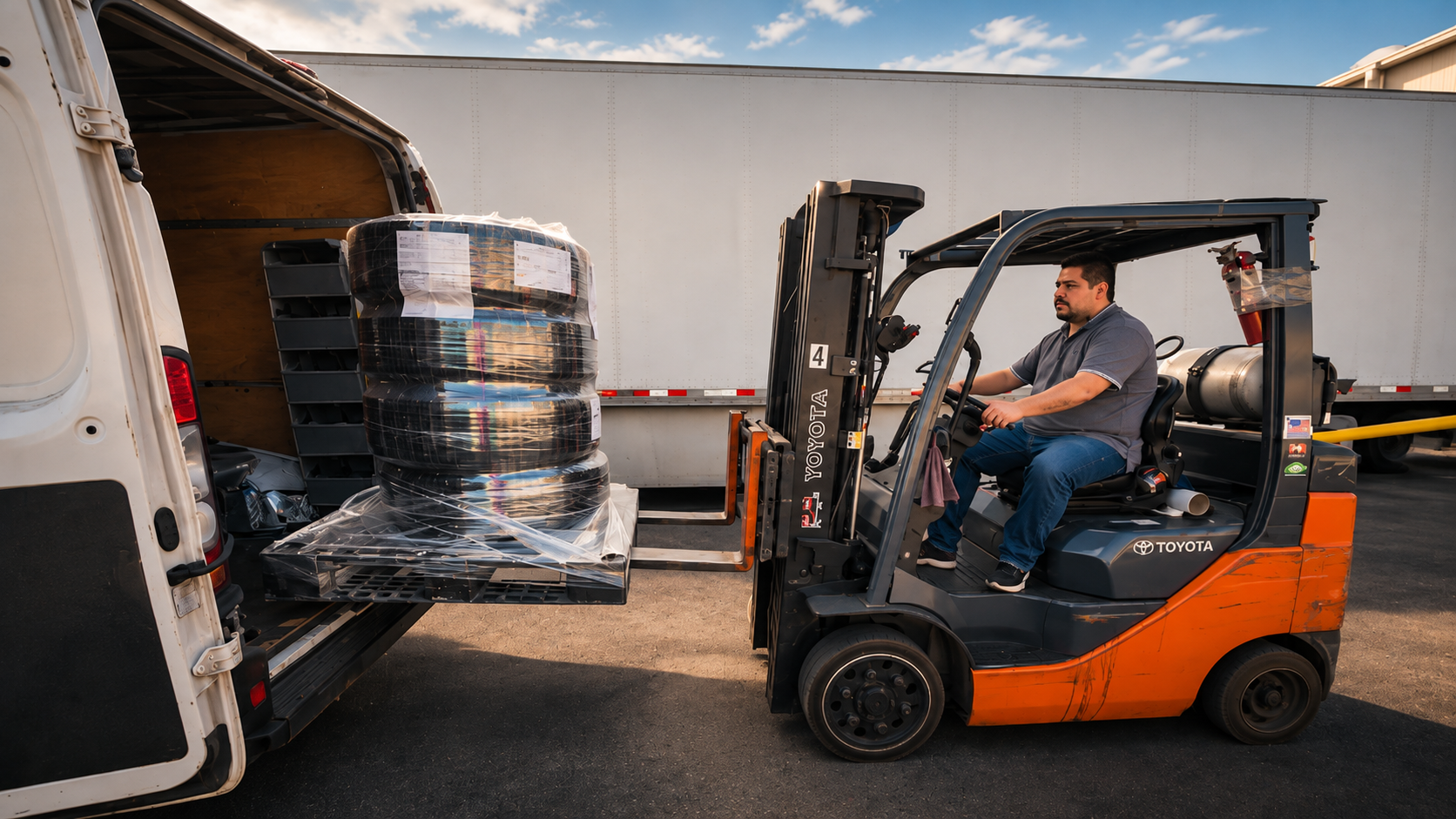
An international shipment can arrive on schedule and still miss its final delivery. The difference often comes down to what happens after the freight reaches the United States.
For freight forwarders, coordinating air and ocean transportation is only part of the logistics process.
Once cargo arrives at an airport, seaport, or inland facility, another critical stage begins.
The freight needs to be released, collected, transported, and delivered according to the customer's requirements.
That process may involve airport cargo recovery, drayage, expedited trucking, warehouse transfers, or final-mile delivery.
Each movement introduces additional coordination requirements.
A shipment may be available for pickup later than expected. A truck may arrive without the correct release information. A delivery appointment may change. Or the equipment assigned to collect the freight may not meet the shipment's handling requirements.
These situations can affect more than the transportation schedule.
They can also influence the freight forwarder's relationship with its customer.
That's why choosing the right domestic transportation partner is an important part of managing international freight.
Here are seven factors freight forwarders should evaluate before selecting a trucking and logistics partner in the United States.
1. Understanding the Freight Handoff Process
One of the most important capabilities of a domestic transportation partner is understanding how freight transitions between transportation providers and facilities.
For freight forwarders, the process often begins before a truck is dispatched.
Consider an air freight shipment arriving at a major U.S. airport.
The aircraft may have landed, but that doesn't necessarily mean the cargo is available for pickup.
Before recovery, several conditions may need to be satisfied.
These can include:
Cargo availability confirmation.
Applicable customs release requirements.
Airline or ground handler release procedures.
Air Waybill (AWB) information.
Pickup authorization and reference numbers.
Facility operating hours.
Required driver identification or access credentials.
The specific requirements depend on the shipment, facility, and applicable regulations.
A truck arriving before the freight is available may create unnecessary waiting time or a failed pickup attempt.
Why freight readiness matters
A reliable transportation partner should verify the relevant pickup requirements before dispatch.
This means understanding the difference between the shipment's estimated arrival time and its actual availability for collection.
For example, a flight may arrive at 10:00 a.m., while the cargo isn't available for pickup until later in the day.
Dispatching a truck based exclusively on the flight arrival time could result in an avoidable delay.
A more effective approach is to coordinate with the forwarder and relevant handling facility to confirm the cargo's availability and release status.
The transportation plan should begin with verified freight readiness, not assumptions about when the cargo will be available.
2. Access to the Right Equipment and Transportation Solutions
Freight forwarders handle shipments with different dimensions, weights, service requirements, and delivery deadlines.
A single equipment type cannot efficiently accommodate every movement.
That's why a domestic transportation partner should be able to evaluate the shipment and identify an appropriate transportation solution.
Sprinter Vans
Sprinter vans can be useful for smaller, time-sensitive shipments that fit the vehicle's capacity and handling limitations.
They may be appropriate for urgent airport recovery or direct delivery movements when the shipment doesn't require larger equipment.
Straight Trucks
Straight trucks provide additional capacity for shipments that exceed the practical limitations of smaller vehicles.
Depending on the configuration, they may also offer liftgate equipment for deliveries to facilities without conventional loading docks.
Full Truckload Transportation
For larger shipments, a dedicated truck may provide the capacity and service configuration required.
Full truckload transportation can be particularly relevant when freight needs to move directly between facilities without sharing trailer space with unrelated shipments.
LTL and Partial Truckload
Smaller shipments may benefit from less-than-truckload or partial truckload solutions.
However, the suitability of shared capacity depends on transit requirements, handling conditions, and the service expectations of the forwarder.
Drayage
Ocean freight movements may require drayage transportation between ports, container yards, rail ramps, warehouses, and distribution centers.
These operations introduce additional requirements involving chassis availability, terminal procedures, appointment windows, and container return deadlines.
Why equipment flexibility matters
Imagine a freight forwarder coordinating three shipments.
The first consists of a small number of urgent cartons requiring direct delivery.
The second involves several pallets that need liftgate service.
The third is a full container arriving at a seaport.
Each shipment requires a different transportation approach.
A capable domestic transportation partner should evaluate these needs rather than automatically assigning the same type of equipment.
The right transportation solution depends on the freight, the deadline, and the operational requirements of the movement.
3. Carrier Verification and Transportation Security
When freight forwarders work with domestic trucking partners, carrier verification is especially important.
The forwarder may be responsible for coordinating the customer's transportation requirements, but the actual freight movement depends on qualified transportation providers.
A freight brokerage partner should have a structured process for evaluating carriers before dispatch.
Relevant checks may include:
Appropriate operating authority.
Insurance coverage.
Available safety information.
Carrier identity verification.
Equipment compatibility.
Driver and dispatch information.
Shipment-specific qualifications.
Additional considerations for air cargo
Certain air cargo movements may involve Transportation Security Administration (TSA) requirements.
Depending on the operation, the transportation provider may need to comply with security procedures related to cargo handling, access, or maintaining the integrity of screened freight.
These requirements depend on the regulatory status of the parties involved and the specific transportation arrangement.
A freight forwarder should confirm that the assigned transportation partner understands and can meet the applicable requirements.
Why does this matter?
Imagine a time-sensitive shipment requiring pickup from an airport cargo facility.
A truck may be available nearby.
But if the driver lacks the necessary access credentials or the transportation provider cannot comply with the applicable security procedures, the movement may not proceed as planned.
A competitive rate doesn't resolve that problem.
Reliable domestic transportation begins with selecting carriers that meet the operational and security requirements of the shipment.
4. Realistic Pickup and Delivery Coordination
Speed is often a major consideration in freight forwarding.
Air cargo movements may involve strict delivery deadlines, customer commitments, or time-sensitive distribution requirements.
But promising a fast pickup is not the same as confirming a feasible transportation plan.
The actual schedule depends on several factors.
These include:
When the freight becomes available.
Pickup facility requirements.
Driver and equipment availability.
Distance and transit conditions.
Required delivery appointments.
Unloading or receiving restrictions.
Airport recovery requires coordination
Consider a shipment that becomes available at an airport cargo facility late in the afternoon.
The final delivery location operates only during standard business hours.
Even if a truck can collect the shipment quickly, the receiving facility may not accept delivery until the following morning.
The transportation plan must account for both the pickup and delivery conditions.
A reliable partner should clarify whether direct delivery is feasible, whether an appointment is required, and whether an alternative arrangement is necessary.
What should freight forwarders expect?
Before accepting a transportation plan, the forwarder should understand:
Pickup readiness: Is the cargo available and authorized for collection?
Equipment availability: Has suitable transportation capacity been identified?
Transit expectations: Does the schedule reflect realistic travel and handling requirements?
Delivery feasibility: Can the destination receive the shipment within the proposed window?
Contingency planning: What options are available if the original schedule changes?
Not every disruption can be predicted.
However, realistic planning reduces the likelihood of commitments being made without sufficient operational information.
Reliable transportation isn't about promising the fastest possible movement. It's about confirming a plan that can realistically be executed.
5. Shipment Visibility and Proactive Communication
Once a shipment has been collected, the freight forwarder needs accurate information about its status.
This becomes particularly important when the forwarder is responsible for communicating updates to its own customer.
A lack of information from the domestic transportation provider can create unnecessary uncertainty.
For example, a customer may contact the forwarder asking whether their cargo has been collected.
If the transportation partner hasn't confirmed the pickup, the forwarder may need to contact multiple parties to determine what happened.
That creates additional administrative work and slows communication.
What should shipment visibility include?
Depending on the movement, useful updates may include:
Pickup confirmation.
Driver check-in.
Cargo loading completion.
Departure confirmation.
Current shipment status.
Estimated time of arrival.
Potential delays or exceptions.
Delivery confirmation.
These milestones help the forwarder maintain an accurate understanding of the operation.
However, location information alone isn't enough.
A truck may be moving toward its destination while still facing circumstances that affect the delivery commitment.
Proactive communication makes the difference
Consider two possible updates.
Update A:
"Shipment delayed."
Update B:
"Pickup was completed at 2:15 p.m. The driver is now in transit. Due to congestion along the route, the estimated delivery time has changed from 5:00 p.m. to 6:30 p.m. We're confirming whether the receiving facility can accommodate the revised arrival."
The second example provides information that helps the forwarder make decisions.
It identifies the situation, explains the potential impact, and describes the next step.
This is particularly valuable when the freight forwarder needs to communicate with its customer.
A strong domestic transportation partner should make shipment information easier to access, understand, and communicate.
6. Flexibility for Multiple Shipments and Delivery Requirements
Freight forwarding operations don't always involve a single shipment moving between two locations.
A forwarder may need to coordinate several shipments arriving at the same airport.
Those shipments may have different delivery addresses, service requirements, or receiving schedules.
In these circumstances, transportation planning becomes more complex.
Consider three shipments arriving at the same cargo facility.
One needs to move to a warehouse north of the airport.
Another requires delivery to a commercial facility farther away.
The third has a strict appointment window at a distribution center.
Booking a separate truck for each shipment may be appropriate.
However, depending on the freight, routes, schedules, and handling requirements, consolidation or multi-stop transportation may offer another option.
When does shipment consolidation make sense?
Combining compatible shipments into one transportation movement can sometimes reduce duplicated transportation costs.
But it isn't automatically the most efficient solution.
Before consolidating freight, the transportation partner should evaluate:
Total shipment volume and weight.
Equipment capacity.
Cargo compatibility.
Required delivery windows.
Loading and unloading sequence.
Route efficiency.
Handling restrictions.
Additional stop charges.
A consolidation plan that reduces the initial trucking cost but causes a missed delivery appointment may not provide the desired result.
Flexibility matters more than a single solution
A reliable partner should help evaluate the available transportation options.
Sometimes the right decision is a dedicated vehicle.
Other times, a multi-stop movement or consolidated load may better match the operational requirements.
The best transportation plan isn't always the one with the fewest trucks. It's the one that balances cost, timing, and execution.
7. Complete Documentation and Transparent Freight Closeout
A domestic transportation movement doesn't end when the truck reaches the destination.
Freight forwarders also need accurate documentation confirming that the transportation service was completed.
These records are important for operational visibility, customer communication, and invoice reconciliation.
Depending on the shipment, relevant documentation may include:
Pickup confirmation.
Applicable shipping documents.
Air Waybill references.
Delivery appointment records.
Proof of Delivery (POD).
Delivery timestamps.
Damage or shortage notations.
Supporting documentation for additional charges.
Why documentation matters
Consider a customer questioning whether a shipment arrived within the agreed delivery window.
A verbal confirmation may not be sufficient to reconstruct the timeline.
A signed POD, recorded timestamps, and relevant carrier communications can help establish what occurred.
These records may also be important when reviewing detention, layover, lumper, or other additional transportation charges.
Transparent billing is part of reliable service
A freight forwarder should be able to understand what was included in the original transportation agreement and why any additional charges were requested.
That requires reviewing the applicable terms and available documentation.
Not every accessorial charge is incorrect.
But each should be supported and evaluated according to the transportation agreement.
For forwarders managing multiple shipments and customers, consistent closeout procedures can also make internal reconciliation easier.
A reliable transportation partner should provide clarity through the final delivery record and invoice, not just during transit.
Domestic Transportation Partner Checklist for Freight Forwarders
Before selecting a trucking or freight brokerage partner, consider the following questions.
| Evaluation Area | What to Ask |
|---|---|
| Freight readiness | Does the partner understand cargo release requirements and pickup procedures? |
| Equipment | Can the partner coordinate appropriate capacity for different shipment types? |
| Carrier verification | How are carrier authority, insurance, identity, and qualifications evaluated? |
| Pickup and delivery | Are transportation schedules based on verified operational conditions? |
| Shipment visibility | How are milestones, delays, and relevant updates communicated? |
| Operational flexibility | Can the partner evaluate expedited, multi-stop, and consolidation options? |
| Documentation | How are delivery records and additional charges reviewed? |
These questions help freight forwarders compare transportation partners beyond availability and initial rates.
A competitive price remains important.
But the coordination behind that price can influence the entire shipment experience.
How Ace Lane Logistics Supports Freight Forwarders
At Ace Lane Logistics, we understand that freight forwarders need more than access to trucking capacity.
They need transportation partners who understand the importance of timing, cargo requirements, documentation, and communication.
Our freight brokerage approach is designed to support those operational needs through a network of vetted carriers and coordinated transportation solutions.
Airport Recovery and Final-Mile Transportation
We coordinate airport cargo recovery and final-mile delivery using appropriate transportation equipment, including sprinter vans and straight trucks.
Our approach includes coordinating relevant pickup references, labels, Air Waybill information, and facility requirements.
For shipments involving specialized security requirements, we work with appropriately qualified carriers according to the needs of the movement.
Expedited Transportation
Time-sensitive freight may require dedicated equipment and direct transportation.
Our expedited solutions include sprinter vans, straight trucks, and other appropriate capacity based on shipment requirements and availability.
We evaluate the pickup conditions, delivery expectations, and transportation options before confirming the movement.
Drayage and Freight Transfers
For ocean and intermodal movements, we coordinate drayage transportation between ports, terminals, warehouses, and distribution centers.
We also offer access to partner facilities for cross-docking, transloading, and related freight-handling requirements.
Carrier Verification and Shipment Visibility
Through The Ace Standard, our approach emphasizes:
Accountability. Clarity. Execution.
Our Verified Checkpoint System supports the shipment across critical stages, including carrier verification, loading coordination, in-transit visibility, and delivery closeout.
We use tracking technologies, including MacroPoint and Samsara, alongside carrier communication to monitor relevant transportation milestones.
Our approach also includes reviewing delivery documentation and additional charges against the agreed transportation terms.
A Transportation Partner Focused on Execution
We believe a reliable domestic transportation partner should make freight coordination easier, not introduce another layer of complexity.
That's why our approach is built around understanding the shipment requirements, selecting qualified transportation providers, and maintaining communication throughout the movement.
From airport cargo recovery to final-mile delivery, every checkpoint contributes to the overall transportation experience.
Because for freight forwarders, a successful shipment depends on more than getting cargo into the country. It also depends on what happens next.
Looking for a Reliable Domestic Transportation Partner in the United States?
Whether you're coordinating airport recovery, time-sensitive deliveries, drayage, or ongoing domestic freight movements, choosing the right transportation partner is an important part of your operation.
At Ace Lane Logistics, we help freight forwarders coordinate U.S. ground transportation with attention to carrier qualifications, shipment requirements, visibility, and delivery documentation.
Tell us about your operation.
Share your pickup location, cargo details, transportation requirements, and delivery expectations.
Our team can help evaluate the available options for your next shipment.
Partner With Ace Lane Logistics.
sales@acelanelogistics.com
ACE LANE LOGISTICS
Built to Deliver Excellence.